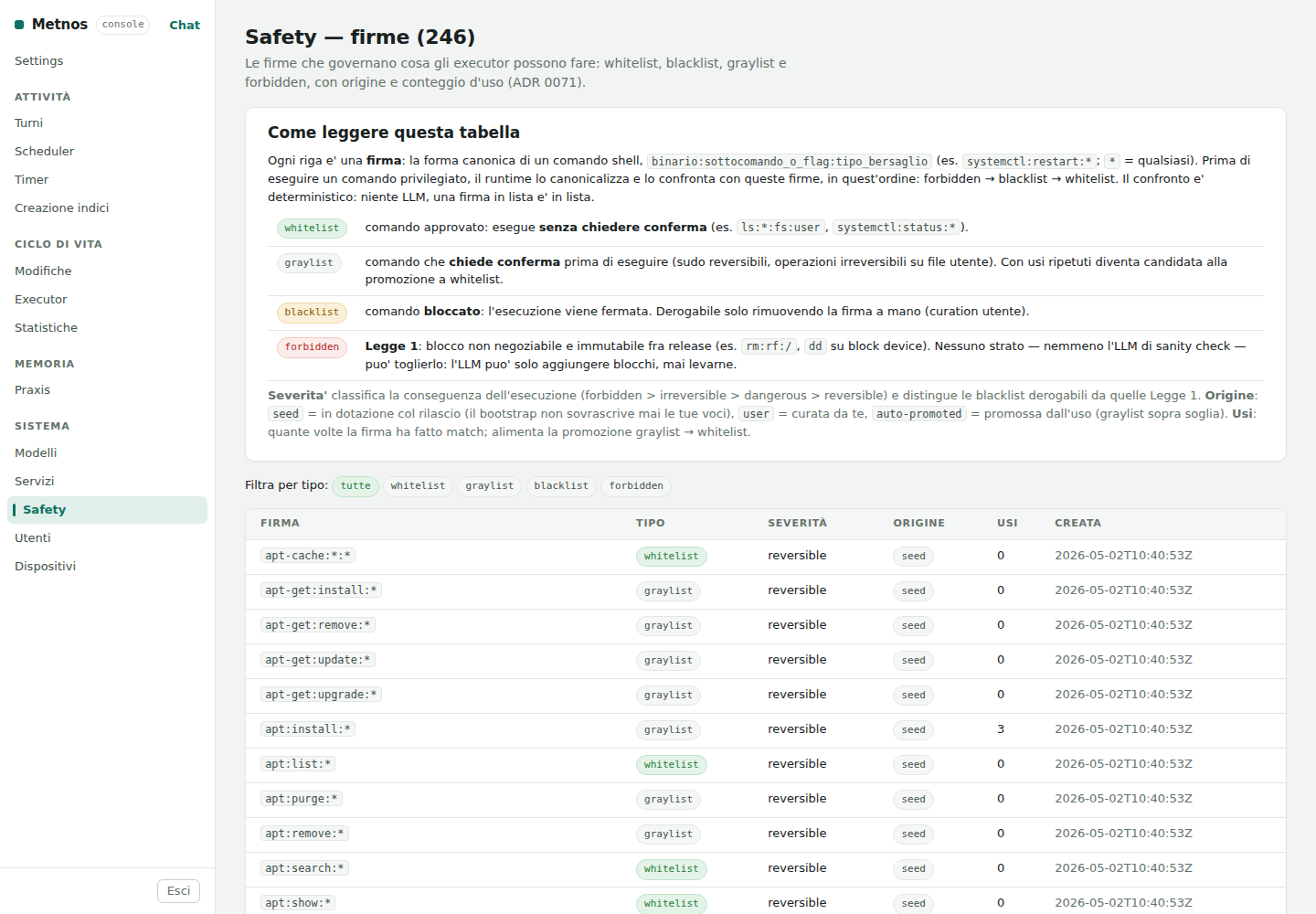
The Safety page makes visible the deterministic signatures that govern privileged commands. Before execution, Metnos converts a command to a canonical form and compares it with explicit rules. This decision is not delegated to a language model.
A signature describes the shape of a command, such as the program executed, action,
and target type. The * symbol represents a component admitted as
variable. Canonicalisation prevents purely formal differences or displaced
arguments from bypassing the control.
| Class | Effect |
|---|---|
| whitelist | The command is approved and may proceed without another confirmation. |
| graylist | The command requires explicit approval before execution. |
| blacklist | The command is blocked; a deliberate administrative edit can change the rule. |
| forbidden | The command violates a non-negotiable prohibition and cannot be released by a model or ordinary approval. |
The strongest prohibitions are applied first. Severity describes the potential consequence, while source distinguishes distributed, user-curated, and rules acquired through the established process. Usage counts support review, but never turn an absolute prohibition into permission by themselves.
A whitelisted signature does not grant authority to a user on its own. Identity, role, autonomy, data ownership, executor policy, and source scope continue to apply. The signature answers a narrower question: may this form of command proceed, does it require approval, or must it be stopped?
Approval likewise cannot override forbidden. A model may flag an
additional risk, but it cannot remove a deterministic block. This order keeps
persuasive wording from replacing a safety rule.
Use the filters to isolate a class, find the command's canonical signature, and inspect severity, source, and match count. If an action was stopped, do not add a broader rule than necessary: review the most specific signature and the actual target.