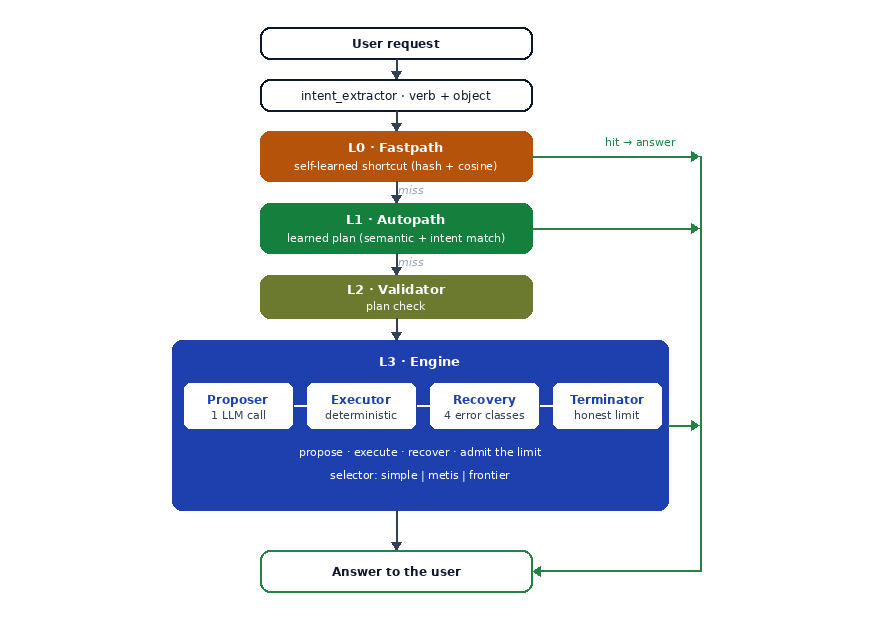
Metnos is an agent governor that you can install on a local computer. It receives a request, decides which capabilities may satisfy it, controls their use, and records what happens. Metnos does not come with inherent access to email, browsers, or filesystems: the executors admitted by an installation define what it can actually do.
The reference installation can work as a personal or household assistant. That use case does not define Metnos itself. Give the same governed core a different admitted executor catalog and it can support software maintenance, research, or another clearly bounded operational domain.
The core plans, judges, remembers, and records. Executors act. This separation stops a language model from automatically inheriting the privileges of the computer that hosts it. A model may propose “read these files, compare them, and create a report”; only declared and admitted executors can perform those steps.
| Part | Responsibility | What it cannot do on its own |
|---|---|---|
| Channel | Receives the request and identifies the user, conversation, and language. | Grant capabilities or bypass controls. |
| Runtime | Coordinates the turn, builds or reuses a plan, and keeps its context. | Run arbitrary commands outside the catalog. |
| Policy and Vaglio | Check authority, risk, destination, and whether confirmation is required. | Turn a confirmation into unlimited permission. |
| Executor | Performs one bounded action under a signed contract. | Expand its own mandate while it runs. |
| Records and memory | Keep outcomes, receipts, and useful relationships between operations. | Invent success or grant authority. |
Consider this request: “Find the PDF reports received this week, summarise them, and save the summary in the Projects folder.”
When someone asks how Metnos works, Tutor searches admitted public sources and may retrieve a small set of current, read-only observations. It does not start an operational executor. If the same sentence also contains a separable action, Tutor explains the informational part and asks before handing the operational part to the ordinary engine.
Metnos does not ask a model to start from scratch every time. It tries the simplest previously verified path first:
A reused plan is not a permanent shortcut. Before execution, Metnos checks the catalog, schemas, and operating context again. If an executor has changed, a relevant alternative has appeared, or a dependency is no longer available, the saved plan is rejected and rebuilt.
Data moves between steps through structured references. Large collections may stay in the turn's scratchpad, so the planner sees what it needs without being given entire mailboxes or file collections. Credentials and other sensitive values are resolved by the runtime only when execution needs them; they are not entrusted to the model.
An action is admitted only when every applicable boundary agrees. There is no single “safe/unsafe” switch.
Confirmation does not create a new power on its own: it authorises a proposal that is already compatible with identity, policy, and contract. Likewise, an executor's presence in the catalog does not mean that every user may run it against every target.
The contract distinguishes three cases. An action can be undoable when it produces a receipt that can restore the previous state; not undoable when it changes data without a reliable inverse; or not applicable when a read or pure computation leaves nothing to restore. The executor catalog shows the classification derived from the manifests.
Executors normally run on the computer that hosts the Metnos server. A user may also pair another computer, such as a Windows laptop. The runtime chooses that device only when the plan requires it, the executor is compatible, and the user has the necessary authority.
The device client does not decide what to do. It receives an authorised invocation, applies the contract and sandbox available on that operating system, records the outcome, and returns a receipt to the server. If the device is unreachable, Metnos does not pretend that the action ran: it stops or, for work that supports it, offers to defer the action.
Transport does not change an executor's meaning. The same capability must keep the same arguments, results, and authority whether it runs locally or on a remote device.
Metnos keeps several kinds of state, each for a specific purpose:
| State | Purpose | Lifetime |
|---|---|---|
| Conversation | Maintains continuity between messages and devices belonging to the same user. | While the conversation remains available. |
| Scratchpad | Holds large results during a single turn. | Temporary and tied to the turn. |
| Turn record | Documents the plan, controls, observed outcomes, and errors. | According to the instance's retention rules. |
| Mnest and mnestome | Record useful relationships between executors and consolidate operational experience. | Persistent, with maintenance and decay. |
| LRE | Runs long jobs as persistent, bounded, resumable units of work. | Until completion or closure. |
None of these memories grants capabilities. Remembering that two executors worked well together does not authorise the second to read data that the first could not lawfully pass to it.
A new capability enters the system as an executor, not as a free-form prompt instruction. It needs a name from the admitted vocabulary, a schema, declared effects and resources, tests, a signature, and placement rules. Only after admission does it appear in the catalog available to the planner.
Synt can compose existing capabilities or prepare a new executor when one is genuinely needed. Imported skills cross the same boundary: their content is translated into Metnos capabilities, checked, and admitted. Third-party code does not automatically inherit the instance's privileges.
Executor names combine one action and one object from a closed vocabulary. It currently contains 28 actions and 27 objects. This lets “read files” and “read messages” share a verb without turning them into the same capability.
Actions: read,write,move,delete,create,find,list,filter,sort,group,classify,get,set,send,describe,render,extract,compress,compute,compare,change,order,share,open,login,act,install,run.
Objects: files,dirs,packages,messages,events,contacts,places,processes,urls,numbers,images,signatures,texts,proposals,persons,tasks,inputs,approval,credentials,issues,pulls,calendars,entries,lists,skills,sites,preferences.
When a plan needs to work on a collection it has already obtained, it uses shared operators instead of creating a domain-specific variant. The structural operators are filter_entries,filter_lists,sort_entries,group_entries,compute_entries; the semantic operators are classify_entries,compare_entries,extract_entries,describe_entries.
| If you want to understand… | Continue here |
|---|---|
| how the runtime turns a sentence into a plan | Request runtime |
| which actions exist today | Executor catalog |
| what Metnos can do in each operational area | Domain reference |
| where to find features and settings in the web chat | Interface guide |
| how paired computers work | Remote executors and device pairing |
| how requests reach Metnos | Conversation channels and web chat and HTTP API |
| how permissions and limits are applied | Policy and authority, confirmation, and sandboxing |
| how Metnos explains itself without acting | Tutor |
| how to observe an installation | System section |
This guide describes implemented behaviour. For inventories that change over time, such as the list of executors, it links to pages generated from current contracts instead of copying counts that would soon become stale.